Sunday, January 20, 2013

Red Roof and Bay Window Gottschalk - Antique Dollhouse

This lovely little house has a red roof and many other characteristics of a Gottschalk dollhouse. The latice pattern above the front door is often found on that brand of house. The pressed cardboard window frames for the tiny panes in each window are also a Gottschalk trait.

I love the configuration of the recessed front door with the box window above it. It is unusual, as is the 5-bay window on the other side.

Here is a picture of the dollhouse from the Gottschalk catalog. I don't know if my window panes are original as they are very different from these, but the rest of the house looks very much the same as this.

Perhaps mine is a later issue. My front door is lighter. The base on mine does not have a brick pattern. it may have been removed or it may have never existed if mine is a later edition.
The house also has the typical Gottschalk door with the paint outlines, and metal door knob.

The house has four rooms and an attic. The entry hall to the house has a removable staircase and a closet at the back. Gottschalk houses typically have a toilet in that closet, but this house is missing it.

Some well meaning soul decided to "fix up" this house and has stripped off the original floor and wall papers.


Remnants of the original wall paper are in the room above the stairs and both rooms on that side of this house have some of their original floor papers.

It just about breaks my heart to see these "improvements" but what happens to a dollhouse before it comes to me is out of my control. I may seek out reproductions of the original papers and try to undo the damage.

Here are the two larger rooms with their new wall paper. Yes, it's pretty, but it is not appropriate for this house.

The outside of the house has also been stripped. I wish I could find a picture of what it is supposed to look like so I could restore it. I am sure one will show up sooner or later.

I decided to furnish the house with Golden Oak Schneegas and German red stain furniture from the first decade or two of the twentieth century.

In the front hall little Freddie and Pal are playing with a couple of wooden toys. behind Freddie is a Schneegas chair with an upholstered seat and back.

The rug is a tobacco felt.
On the opposite wall is a German red stain buffet with a stemmed brass bowl on it. The large pink vase is contemporary to the room as well.


Gran is in the parlour. She has just enjoyed a nice cup of tea. But if all Gran had was tea why is that wine glass on the tray? Hmm ...

Most of the furniture in here is red stain, but the lamp is my only piece of Westacre furniture. Westacre was a company in England that made lovely hand crafted dollhouse furniture circa 1920/1930. I have heard it called the English Tynietoy, although it is very different in design.
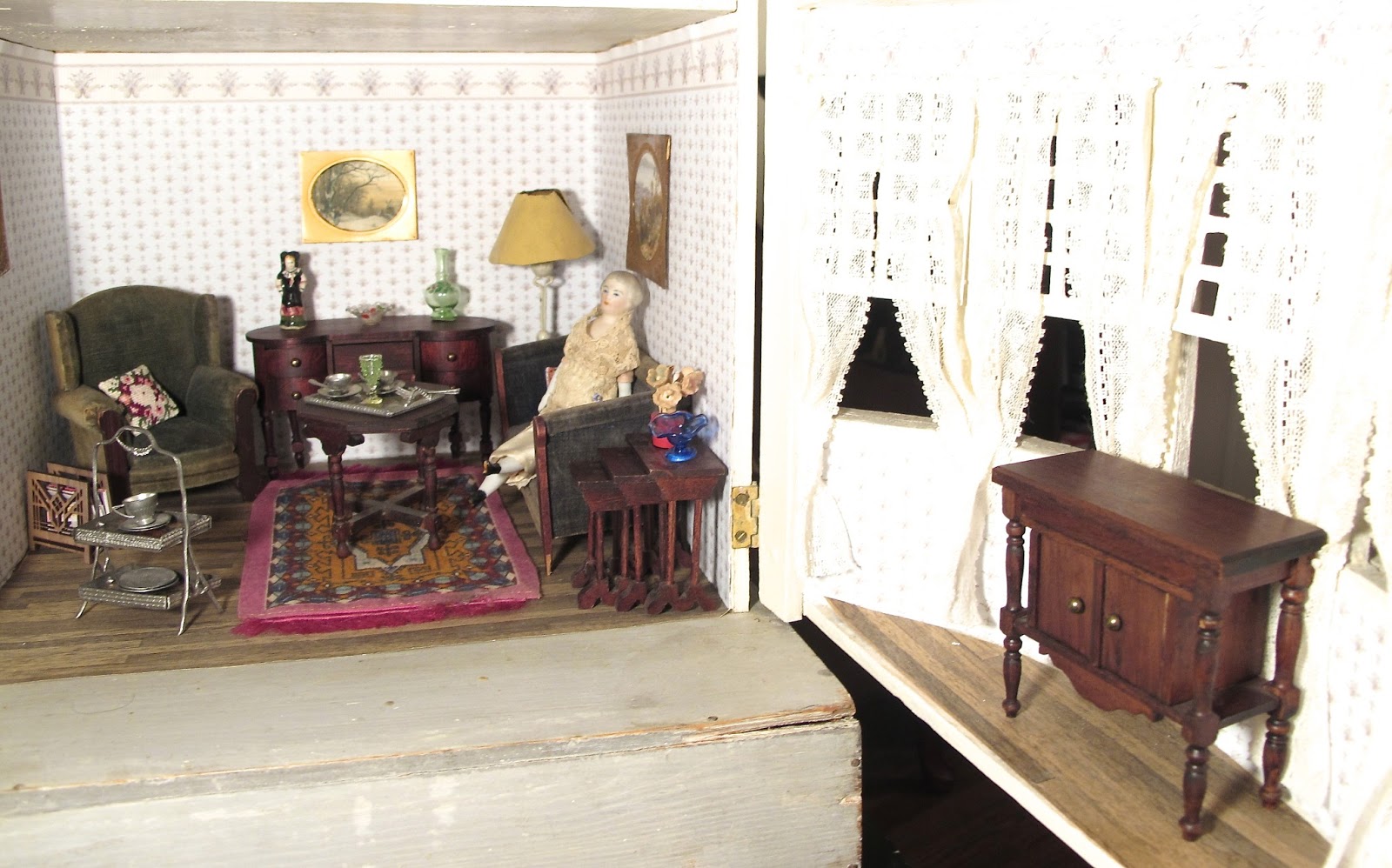
The couch and chair are red stain as are the nesting tables, buffet and centre table. The metal pieces are from the early 20th century and were common dollhouse accessories at that time

In the bay window is a lovely little red stain radio.


When you lift the lid you find the radio knobs. Open the door and there is the speaker. I am sure the family is very proud to own such a fine appliance.

Beside the wing chair in the living room is a wonderful magazine rack. Troy of Tulsa Tiny Stuff made this and I was lucky enough to win it when he did a give-away to celebrate 100 followers on his blog.

Isn't it wonderful? I think it goes so well with this chair.

The rug is a tobacco felt. The needlepoint cushions are new, but they look so nice with the green velvet I decided to use them.

Upstairs Father has a beautiful Schneegas golden oak desk in his study.

The shelf above the desk with the protruding nails was in the house when I got it. I have no idea whether it is original. It looks a little rough, so I am not sure.


Behind Father is a comfy Schneegas chair where he can relax when he is not working and a metal heater to keep him cozy. There is an elaborate clock on the wall which, unfortunately, is missing its turned wood decorations at the top.

Another tobacco felt is on the floor.

Mother is in the bedroom. It is also furnished with Schneegas golden oak. There is a smaller, less elaborate desk in here, but Mother likes it just fine.

In the bay window of the bedroom is a nice little washstand with pressed designs in the doors.

The decorative glass pieces throughout the house are all mouth blown. This type of glass was available for dollhouses for hundreds of years. I don't know the exact age of my pieces, but I am sure that some are from the early 20th century and I think some is mid-20th century.

When I have a small dollhouse like this I feel that rooms we don't see - the kitchen, children's room and Granny's room, etc. - are in a part of the house that exists only in my imagination.

That makes sense to me and I don't have to worry about trying to make the house functional. I can just decorate the rooms any way I wish.

This house though does have an extra area that we can see.

As with many Gottschalk dollhouses this one has a door to the attic. For an adult this space is not much good for anything but storage, and even that is not very convenient for larger hands.

But a child could put furniture in here and have a maid's room or a nursery. 


Don't you just love the painted windows on the side. They are on the opposite side as well. This sides are grey and the painted windows appear to be intact, so I guess this is the original paint colour.
This was the third dollhouse I had in the car last July when I returneed from Pennsylvania after picking up my Tynietoy Townhouse and my Christian Hacker dollhouse.

I have finally gotten around to blogging it. I hope you enjoyed the tour.

Hugs,
Susan

And, the Rosetta Stone Award goes to ...

It is time to pass on the Rosetta Stone Award. The Award is given to a dollhouse blogger who has contributed greatly to the information of dollhouse history. The award is kept for six months and then passed on to another worthy recipient.

The Rosetta Stone award was created by a committee  on My Realitty's blog. CM explained the creation of the award in this way.... "As we all know dollhouses were originally the hobby of the rich or tools to teach children how to keep house. Today people all over the world are interested in them. Note the number of bloggers and how dollhouse blogs are a world unto themselves. Though these houses may have started as toys and may have led a perilous life, once they are in the safe harbor of the collector they have a story to tell. This award is to acknowledge the sleuthing it takes to discover that story."

Previous winners have been collectors of great knowledge and generosity, and authors of some of my very favorite blogs. Check out their latest posts..... Rebecca's Collections ... from Australia, diePuppenstubensammlerin ...f rom Germany, A Home for Dolly ...f rom Ohio, USA, and Florine at My-vintage-dollhouses ... from Arizona, USA.

I  would like to pass the award on to Troy of Tulsa Tiny Stuff.

Troy has a wonderful collection of dollhouses and miniatures and is very generous about sharing with us. I always enjoy reading his blog and look forward to each entry.

I felt honored to be included among the winners of the Rosetta Stone Award and am happy to pass it on to the next recipient.

Congratulations Troy!

Sunday, January 6, 2013

Mouse miniatures - Fool on the HIll

I recently watched the movie "Dinner for Schmucks" To my delight, the opening credits are a series of miniature scenes accompanied by Paul McCartney singing Fool on the Hill. Watch the credits here:
Also check out this link to learn about how the miniature scenes were created: Art of the Title. It has some interesting information about how the idea came about and how the dioramas were set up.

Below are some of the scenes.

I enjoyed the movie very much even though the main character, Barry, played by Steve Carell, can be quite frustrating to watch at times.

It is a story about an underdog with a unique talent who proves his worth despite his shortcomings.

The wonderful mouse dioramas are featured throughout the movie and are expertly done.

I would recommend it, not only for the miniatures, but for the sweet story and the rather obvious moral.


If you subscribe to Netflix you can find it there. Enjoy!

Susan

Saturday, January 5, 2013

Round Shingle House at the Strong Museum - Antique Dollhouse

I took a lot of pictures the day I visited the Strong Museum of Play in Rochester, New York. I have many more to share with you in future posts, but today I want to share the Round Shingle Dollhouse, circa 1920. It is filled with beautiful Tynietoy and Lynnfield furniture.
The house as displayed in the Strong Museum. It is dated 1920 by the Museum, which would make the Tynietoy furniture contemporary with the house. I think the Lynnfield furniture was created later, perhaps beginning in the 1940s.
The top floor bedroom has beautiful blue Tynietoy furniture


The other third floor bedroom has the Tynietoy twin sleigh beds in green with a matching dresser. The highboy is also Tynietoy. If the two side chairs are from Tynietoy they are of a design I have not seen before. 

The second floor bedroom has a Tynietoy mahogany double bed and matching dresser. The painted wing chair, lamp, rocking chair and broken front bookcase on the left wall are also from that company. The standing ashtray and metal plant stand beside the bed are Gerlach accessories that were sold by Tynietoy to complement their furniture. I don't recognize the mirror, but it fits perfectly in this room.

The sitting room has a rare Tynietoy secretary on the back wall.  The two wooden side chairs are from Tynietoy's Victorian series. The upholstered pieces are Lynnfield, and the metal accessories are made in Germany, but sold with Tynietoy and Lynnfield furniture.


The kitchen has a Tynietoy dresser, metal Eagle stove and a Lynnfield table with two chairs. I am not sure who made the stove and sink. They may be early Lynnfield.
Don't you love the original light fixtures in each room?
The dining room has a large Tynietoy buffet, a drop leaf table and six Hepplewhite chairs with painted seats.
On the buffet is a Gerlach metal caddy containing real glass tumblers. This was another common Tynietoy accessory, as was the metal tea cart on the left side of the room.
The gardens outside the museum are lovely
The exterior of the Round Shingle House

Saturday, December 1, 2012

Combination Doll House by Stirn & Lyon - Antique Dollhouse

I know that my favoutite Sunday morning outing, the St. Lawrence Antique Market in Toronto, offers rare and unusual treasures, but I was blown away when I came across this one and I bought it immediately.
The Combination Doll House made  by New York firm Stirn & Lyon was patented in 1881.

The houses came unassembled in wood boxes. The box served as the base for the house and the box top became the roof.

The house pictured on the box label was a little more fancy than the actual doll house.

It appears to be marble, situated in a park-like setting on a river.

Elegant ladies gossip outside the iron fence while a little girl joyfully chases her hoop.
On one side of the house is an elegant fountain in  a manicured garden with cliffs and trees in the background.

On the other side of the house is a gazebo near beautiful flowers in full bloom and where one can watch the sailboats on the river.

An idyllic setting for a beautiful dollhouse. What child (or adult for that matter) wouldn't want to own this magnificent edifice?

Let's see if what's in the box lives up to the picture.
Here is the box with the foundation blocks lithographed onto it. Someone has added strips from cigar boxes to the bottom (which slides off to become the roof). I am not sure why they are there.
Inside the box we find everything we need to build our beautiful house. Or at least we should. As we shall see I am missing some pieces.
The panels for the exterior of the house have the bricks and window details lithographed on in blue ink. The wood panels are very thin and some have split.

A couple of the panels have the windows taped back on.
We start by turning the box over so that it becomes the base of the house.  We insert the dowels of the slotted supports into the holes in the base and slide the panels into them.

Here is the house with the walls up.
This side unfortunately has a piece is missing above the lower window.


There was only one side of the steps in the box and no small pieces to actually make the steps, but I am sure I can make replacements as all I have to do is copy the side of steps I have and cut out wood pieces to lie across the supports.


Also missing were the pieces of wood that attach the balcony and the pediment. Again I think I will be able to make substitutes once I study the house to see how they were attached.


Although this seems like a wonderful toy it is quite flimsy and falls apart if you breathe on it. It must have been quite frustrating for the little ones who actually wanted to play with it.
Here is the interior. I don't know why one of the panels has the exterior printed on the inside too. It looks like a mistake to me.


Just for fun I furnished this house with my candy containers. It's not a bad fit. I have added a tobacco felt rug to cover the illustration of the house on the box top.


This is the back of the house.These two pieces of wood were left over and fit perfectly in the back to close it. I am not sure if this is right but it seems to work.

I will leave you with pictures of other Stirn & Lyon buildings that I found on the internet. These kits can still be found at auction occasionally.

This one is just like mine, but has more small pieces


The East River Suspension Bridge, which we now call the Brooklyn Bridge, opened in 1883 and at that time was the longest suspension bridge in the world.
I'm sure kids wanted their own version and they could get it from Stirn & Lyon.

This is a much larger house but it looks just a flimsy.
This one was once in Flora Gill Jacobs' collection

Here is the interior

A Stirn & Lyon Villa. This one looks later than the one above.

Inside the Villa

A Stirn & Lyon Grocery store

Grocery store box

An 1886 postcard advertising Stirn & Lyon.
It must have been a large store. It has three street numbers