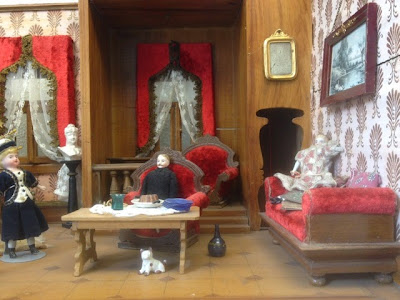
A friend recently acquired some lovely antique dollhouses, but we don't know anything about them. Are they are commercial, or hand made. Are they German? American? British? How old are they?. If you can help identify them please let me know. If not, that's okay too. Thanks for looking.
This one looks like a German house from the early 1900s. Many houses had garages in the 1920s when cars were becoming popular. Could it be a Gottschalk, or an Albin Schonherr? The round bay window is unusual, and it has a small balcony on the upper floor.
This house in Prague has very similar architectural details to the next dollhouse
This house also has a round bay window. It has been heavily restored with new paint and brick paper on the foundation, so it is hard to say what it originally looked like. The side porch and the balcony railing are similar to Gottschalk houses, but the mansard roof is like many Christian Hacker houses. The interior is accessible only by lifting the roof.
This wonderful house has two rooms inside. It looks older then the 2 houses above.
This is the back view
This is the side view.
This unusual house is made to hang on a wall. Doors swing open on the two front sections, but the attic is accessible only from the back where there is a small opening.
The Museum of Science and Industry in Chicago recently completed a 9-month conservation of its Fairy Castle, an elaborate dollhouse created by silent film star Colleen Moore and donated to the museum in 1949.
The Fairy Castle was built with a plumbing and electrical system—the bathtubs have real running water, the chandeliers light—and filled with collected and custom made exquisite objects, like tiny gold plates and crystal glasses, miniature needlepoint tapestries, the smallest Bible in the world, actual Ancient Egyptian mini-statues, and a sliver of the true cross, given to Moore’s friend Clare Boothe Luce by the Pope. The castle cost $500,000 to create in 1935, equivalent to over $8 million in today’s dollars.
Above, you can watch a time-lapse video of the castle being put back together by the conservation team. It shows the objects being placed back into the rooms in accordance with the original intention: to give the impression “that a fairy had been there but left just moments ago.”
For more about Moore’s Fairy Castle, visit The Museum of Science and Industry, Chicago.
All photos and editorial belong to Susan's Mini Homes Blog. No reproduction of the text or photographs may be made without the permission of Susan Hale. Contact Susan at susansminihomes@gmail.com. Thank you.